


Finding God in Ordinary Moments

“Surely the Lord is in this place, and I did not know it.” — Genesis 28:16

We often look for God in the dramatic, the miracle, the healing and the mountaintop revelation. But more often than not, God comes quietly. God comes in the ordinary. In the steady rhythm of our daily lives, grace is hiding in plain sight.

The Everyday Sacred

Kierkegaard once said that “purity of heart is to will one thing.” To live with that kind of focus means seeing every moment, no matter how small,  as belonging to God. Washing dishes, listening to a friend, driving to work, all these are not interruptions to the spiritual life. They are spiritual life when offered with love and awareness.

The sacred doesn’t always announce itself with trumpets; it often whispers through the ordinary.

The Ministry of Presence

As a chaplain, I’ve learned that God often appears in the quiet space between words,  in a held hand, a shared tear, or silent prayer at a bedside. We don’t have to summon God into those moments. God is already there. Our task is to notice.

Presence itself becomes prayer.

Jesus in the Everyday

Jesus met people in ordinary places: on roadsides, around tables, in boats, in homes. He sanctified the everyday by entering it fully. When He broke bread, it wasn’t just a meal; it became communion. When He washed feet, it wasn’t just service; it was divine love embodied in the smallest gesture.

When we slow down enough to see, we find that God is still doing the same — meeting us in our kitchens, our commutes, our quiet mornings.

To find God in ordinary moments, we must practice noticing.
Pause. Breathe. Let the moment be what it is.

Instead of asking, “Where is God?” we might begin to ask, “Where am I not looking?”
When we pay attention, the ordinary reveals itself as holy, not because it changed, but because we did.

Closing Reflection

God doesn’t just dwell in the holy places; God dwells in this place, he is everywhere:  your life, your work, your relationships. The divine meets us where we are.

So pause, breathe, and look around. The sacred is closer than you think.

“Be still, and know that I am God.” — Psalm 46:10
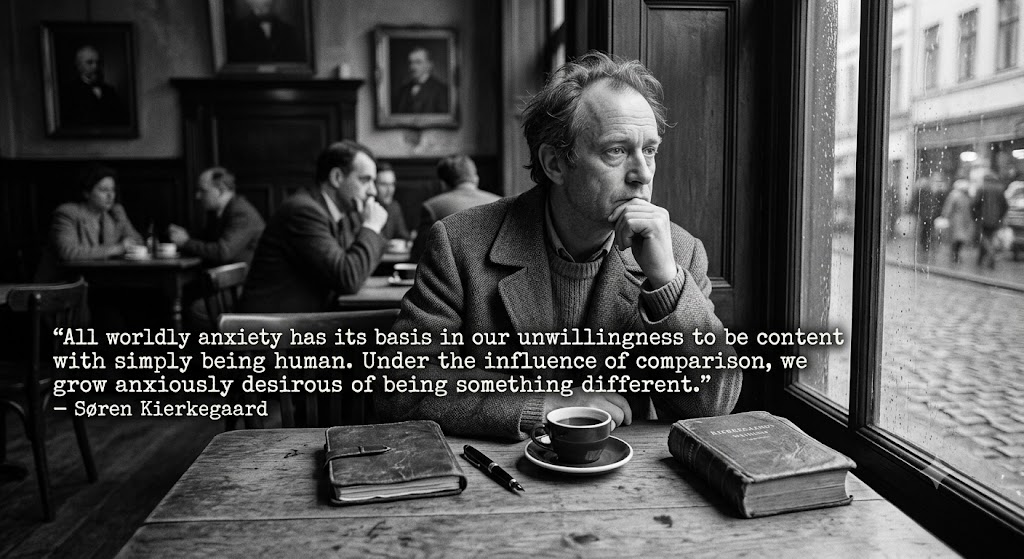
Becoming Ourselves Before God:

Kierkegaard on Anxiety and Comparison

“All worldly anxiety has its basis in our unwillingness to be content with simply being human. Under the influence of comparison, we grow anxiously desirous of being something different.”

— Søren Kierkegaard

There are few forces more quietly corrosive in our lives than comparison. It doesn’t shout, it whispers. It doesn’t confront, it erodes. One glance at someone else’s success, someone else’s calling, someone else’s faith, and suddenly we feel a tightening in the chest—a subtle anxiety that we are not enough, that we must become someone else in order to matter.

Kierkegaard understood this long before social media, long before the constant stream of “other people’s lives” that now flows across our screens. He saw that the deepest form of anxiety emerges not from our circumstances but from our refusal to be at peace with being human.

We want to be more.
We want to be different.
We want to be anyone other than the fragile, finite person we actually are.

The Anxiety of Not Being Enough

When we compare ourselves to others, we enter an arena we were never meant to fight in. Someone else will always pray more beautifully, understand theology more deeply, lead more boldly, write more eloquently, or seem more spiritually grounded. But Kierkegaard warns: the moment we measure our worth by the lives of others, we begin to fracture from within. Anxiety becomes the natural result of a life lived in someone else’s shadow.

Comparison shifts our identity from beloved to evaluated.
From called to competitive.
From known by God to defined by others.

No wonder it makes us anxious.

The Holy Gift of Being Human

What if our task is not to transcend our humanity but to embrace it?

Kierkegaard believed that the self God desires is not a self we manufacture. It is the self we receive—the one created by God, grounded in Christ, and held in love. To be human is not to be inadequate; it is to be a creature designed for relationship, dependence, community, and grace.

To accept being human is to accept limitations.
To accept limitations is to make peace with imperfection.
And to make peace with imperfection is to rest in God.

Anxiety loosens its grip when we stop trying to be “more than human” and rediscover the courage simply to be ourselves before God.

A Way Forward: Returning to the One Who Names Us

The invitation is not to ignore comparison by sheer willpower—that never works. Instead, the invitation is spiritual:

  • Return to prayer, not as performance but as presence.
  • Sit honestly with God, naming the anxieties comparison has stirred.
  • Ask for the grace to see yourself through God’s eyes, not your neighbor’s.
  • Practice gratitude for the life, gifts, and limits you have been given.
  • Let God define you, again and again.

The journey away from anxiety is rarely dramatic. It is slow, steady, and deeply ordinary. It looks like learning to delight in who God made you to be, not who you think you should be.

Becoming Ourselves Before God

Kierkegaard’s reminder is gentle and piercing all at once: the world will always offer you other identities—shinier, louder, more impressive. But God offers you only one: your own.

And that is enough.
More than enough.
Because it is the only identity anchored in love rather than comparison.

The healing begins the moment we stop striving to be someone else and dare to be—before God—ourselves.

How to Find Peace in the Midst of Chaos

“You will keep in perfect peace those whose minds are steadfast, because they trust in You.”
Isaiah 26:3

Life doesn’t slow down when our hearts are weary. The bills still come, the phone still rings, and the world keeps going even when we’re overwhelmed. In moments like these, peace can feel impossible.

However, Scripture reminds us that peace is not the absence of noise, chaos, or conflict — it’s the quiet inner strength that holds us steady within it.

Peace Is Not a Place — It’s a Presence

Many people search for peace as though it’s a far off destination: “If I could just get past this month, then I can rest.”
But real peace isn’t found in control or escape. It’s found in presence, God’s presence, here and now.

The ancient Hebrew word for peace, shalom, means more than calm. It means wholeness, a sense of harmony that comes from trusting that God is near, even when life is chaotic. 

When everything feels uncertain, peace begins with remembering this simple truth:  God is here, you are not alone. 

Simple Practices for Finding Peace

Try these practices when life feels too heavy to carry alone:

  1. Pause and Breathe:  Take three deep breaths. Whisper a prayer like, “God, be my calm.”
  2. Gratitude:  Name one small thing you’re thankful for. Gratitude is a doorway to peace.
  3. Go Out in Nature: Going out in nature can include simple acts like taking a walk, sitting mindfully, gardening, or just stopping to smell the roses.
  4. Reach Out: You don’t have to face the storm alone. Share your burden with someone you trust and who will listen.

These are by no means quick fixes, they are simple tools to remind us that peace is not something we earn, but something we receive.

Reflection

Where in your life are you craving peace today?
Invite God into that space, not to make it disappear, but to fill it with His presence.
Peace doesn’t always change our circumstances, but it always changes us.

I walk beside people who are seeking peace in uncertain times. Whether you’re facing grief, stress, or spiritual weariness, a chaplain can help you rediscover stillness and hope.

Reach out today for a confidential conversation or prayer session.


“Helping hearts find peace in the storm.”

How Chaplains Help People of All Faiths (and No Faith)

“Let us not love with words or speech but with actions and in truth.”
1 John 3:18

One of the most misunderstood parts of chaplaincy is the idea that a chaplain serves only people who share their faith. In reality, a chaplain’s calling is broader and deeper — to meet every person where they are, no matter their belief, background, or doubt.

Chaplains are not gatekeepers of religion; we are companions of the soul.
Our ministry is one of presence, compassion, and care which is freely offered to anyone who is hurting, searching, or simply human.

Meeting People Where They Are

In hospitals, workplaces, homes, schools, and communities, chaplains walk beside people from every walk of life.
We pray with those who believe and sit in silence with those who do not. We listen to stories of faith, fear, and grief without judgment or agenda.

A chaplain’s question is never, “What do you believe?”
It is always, “How are you doing — really?”

That question opens a sacred space. It says, “Your story matters. You matter. I am here for you. You are not alone. 

Love Without Barriers

Jesus often met people who stood outside the walls of religion:  the sick, the doubting, the outcast and He loved them first.
That is the model of chaplaincy: love without condition, care without boundaries, hope without any prerequisites.

The presence of love often speaks louder than the language of doctrine.

Reflection

Is there someone in your life who sees the world differently than you?

What would it look like to simply listen; not to persuade, but to understand?
That, too, is a form of ministry.

When we love without labels, we reflect the heart of God, who is the One who meets us all in grace.

I serve people from all walks of life — believers, seekers, and skeptics alike.
My mission is simple: to offer spiritual care through compassion, presence, and understanding. To me,  every story is sacred.

How to Find Peace in the Midst of Chaos

.

“You will keep in perfect peace those whose minds are steadfast, because they trust in You.”
Isaiah 26:3

Life doesn’t slow down when our hearts are weary. The bills still come, the phone still rings, and the world keeps going even when we’re overwhelmed. In moments like these, peace can feel impossible.

However, Scripture reminds us that peace is not the absence of noise, chaos, or conflict — it’s the quiet inner strength that holds us steady within it.

Peace Is Not a Place — It’s a Presence

Many people search for peace as though it’s a far off destination: “If I could just get past this month, then I can rest.”
But real peace isn’t found in control or escape. It’s found in presence, God’s presence, here and now.

The ancient Hebrew word for peace, shalom, means more than calm. It means wholeness, a sense of harmony that comes from trusting that God is near, even when life is chaotic. 

When everything feels uncertain, peace begins with remembering this simple truth:  God is here, you are not alone. 

Simple Practices for Finding Peace

Try these practices when life feels too heavy to carry alone:

  1. Pause and Breathe:  Take three deep breaths. Whisper a prayer like, “God, be my calm.”
  2. Gratitude:  Name one small thing you’re thankful for. Gratitude is a doorway to peace.
  3. Go Out in Nature: Going out in nature can include simple acts like taking a walk, sitting mindfully, gardening, or just stopping to smell the roses.
  4. Reach Out: You don’t have to face the storm alone. Share your burden with someone you trust and who will listen.

These are by no means quick fixes, they are simple tools to remind us that peace is not something we earn, but something we receive.

Reflection

Where in your life are you craving peace today?
Invite God into that space, not to make it disappear, but to fill it with His presence.
Peace doesn’t always change our circumstances, but it always changes us.

I walk beside people who are seeking peace in uncertain times. Whether you’re facing grief, stress, or spiritual weariness, a chaplain can help you rediscover stillness and hope.

Reach out today for a confidential conversation or prayer session.


“Helping hearts find peace in the storm.”

When God Feels Silent: How to Find Faith in Doubt

“ for we walk by faith, not by sight” 

-2 Corinthians 5:7 

As believers we have not seen proof of resurrection and glorification with their own eyes. However, Paul encourages us to live by faith and to confidently expect God to do what He promised in Christ.          

There are seasons in faith when God feels far away; when prayer seems to be forgotten and the comfort we once felt goes quiet. These are the moments when we start to ask: “Where are You, God?”

If you’ve ever felt this way, you are not alone. Even the saints and prophets knew the ache of divine silence. The Bible is full of people who wrestled with absence — and still chose to trust.

Silence Is Not Absence

When God feels silent, it’s easy to believe we’ve been abandoned. But silence does not mean absence.
Sometimes, God’s quiet is an invitation — a space where faith deepens beyond feelings.

Kierkegaard called faith a “leap into the absurd”  believing even when reason falters, trusting when proof is gone. That’s the essence of mature faith: not constant reassurance, but steady trust in the unseen. Faith involves a risk-taking element, as one must act without certainty of success or rational justification

God may be silent, but He is not still. The silence itself can become sacred ground, a place where we learn to listen differently, to sense His presence not in words but in the quiet strength that keeps us standing.

Faith Beyond Feelings

In the noise of our world, silence can feel like punishment. But sometimes, silence is where God whispers most clearly.
When answers don’t come, we can still cling to what we know of God’s heart, His goodness, His mercy, His faithfulness through every storm.

Faith is not the absence of doubt. It is the decision to trust even when we do not understand

Reflection

Are you walking through a silent season?
Instead of striving to hear something new, rest in what you already know: God’s love has not left you.
Sometimes the silence is where He strengthens your soul to stand on its own and not apart from Him, but deeper in Him.

I understand that faith isn’t always easy. If you’re struggling with silence, doubt, or distance from God, you don’t have to face it alone.

A chaplain can walk with you through the quiet places of faith to help you find peace, purpose, and hope in the midst of uncertainty.

The Table of Christ Has No Reserved Seats

Everyone is Welcome

“Then Levi held a great banquet for Jesus at his house, and a large crowd of tax collectors and others were eating with them.” — Luke 5:29

Jesus didn’t eat with the righteous. He shared meals with those the religious world called sinners. He sat down with the excluded, the scandalized, and the misunderstood. And in doing so, He revealed something radical about the Kingdom of God: there are no reserved seats at His table.

When Jesus called Levi, a tax collector despised by his community, He didn’t first demand repentance, right belief, or moral reform. He simply said, “Follow Me.” (Luke 5:27) That invitation shattered the religious expectations of the day  and it still does.

Too often, the modern church has forgotten this. We’ve turned the open table of Christ into a gated community, by deciding who is “worthy” to belong. LGBTQ believers, divorced people and those with doubts.  All too often they  hear a subtle message: “you can sit near the table, but not at it.” That is, if they are even invited at all.  

But the Gospel says otherwise.
At Jesus’ table, belonging comes before behavior. Love precedes labels. Grace comes before growth.  Everyone is free and deserves to hear the Gospel.  

When Christ broke bread, He wasn’t just offering a meal; He was proclaiming a new world order, one where every person bears the image of God and is welcomed as family. The table is not for the pure, but for the hungry.

If the church wants to be Christlike, it must reclaim that radical hospitality. The mission of the Gospel is not to guard the table, but to set more places.

As a chaplain, I’ve learned that presence matters more than perfection. People don’t need to be fixed before they can be loved. They need to be loved before they can heal. And in every encounter; whether in hospitals, homes, or streets, I see Christ pulling out another chair.

So if you’ve ever been told you don’t belong, please know this: Jesus already saved you a seat.
There are no reservations in the Kingdom. There is only grace.

Prayer

Lord Jesus, break down the walls that divide us.
Teach us to welcome as You welcomed and to love without reservation,
to set tables of grace where all may be fed. Amen.

Why a Chaplain’s Presence Matters

The Ministry of Presence:

There is a quiet kind of ministry that rarely makes headlines and often goes unnoticed by everyone except the person who needs it most. It’s the ministry of presence, showing up, staying near, and bearing witness to another person’s story with compassion and steadiness.

For chaplains, presence is not merely a technique. It is the heart of the vocation.

Presence says, “you are not alone.”  Most people don’t remember the exact words a chaplain says. But they remember that someone was with them.

Presence disrupts isolation. It offers grounding when life becomes disorienting, whether at a hospital bed, a workplace, a fire station, a kitchen table, or a late-night phone call.

In a world that glorifies productivity and speed, presence gives something rare: unhurried attention.

This presence makes space for God.  A chaplain does not bring God into a room; God is already there. However, presence helps people notice God in the midst of their fear, grief, or confusion.

This is called the hiddenness of God; God at work beneath the surface of ordinary encounters.  I  believe that every Christian, in everyday life, could be a bearer of God’s comfort simply by living faithfully, humbly, and attentively.

A chaplain’s presence creates the conditions where the sacred becomes visible.

It is this presence that slowly builds trust.  Trust doesn’t come from impressive credentials or perfect answers.  It grows from consistency.

People open up when they know:

  • You are not rushing them
  • You are not judging them
  • You are not trying to fix them
  • You are not pushing an agenda

Presence communicates safety.  When people feel safe, they can speak truthfully about their doubts, their faith, their guilt, their hopes and in that honesty, healing begins.

This presence honors the dignity of every person.  Chaplains meet people in vulnerable moments—when defenses are low and emotions run raw. Presence honors humanity without demanding anything in return.

It says:

“Your story matters.
Your pain is real.
Your life has worth.”

This is holy ground.

Presence eliminates the need for the perfect words.  Many chaplains worry about what to say. But often the most faithful thing is to say very little.

A hand on a shoulder. A quiet prayer.  A gentle question.  A shared moment of silence.

Kierkegaard reminds us that “purity of heart is to will one thing.”  In chaplaincy, that one thing is love and love expressed through attention, listening, and presence.

Christ’s ministry was deeply relational. He walked beside people, shared meals, entered homes, and lingered long enough to see people as they truly were.

Chaplains follow this pattern, not as saviors, but as companions.

Showing up is the most powerful way to make compassion real. It brings a sense of calm to someone’s hardest moments

A chaplain’s presence does not solve every problem. But it changes the atmosphere of suffering. It helps people breathe again.  It gives strength for the next step.

Presence is ministry.
Presence is compassion.
Presence is hope made tangible.

And sometimes the most sacred work a chaplain can do is simply to show up and stay.