

Kierkegaard on Anxiety and Comparison
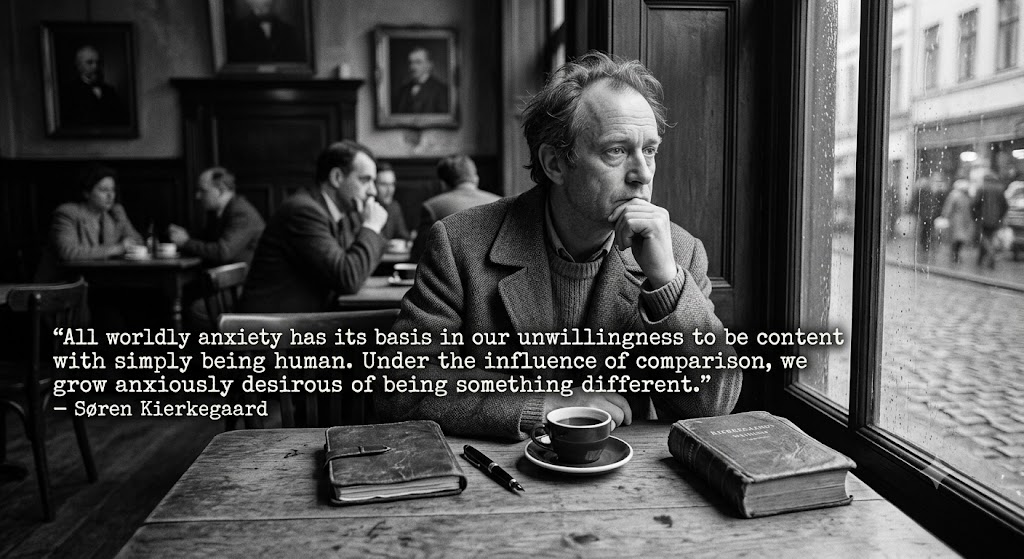
“All worldly anxiety has its basis in our unwillingness to be content with simply being human. Under the influence of comparison, we grow anxiously desirous of being something different.”
— Søren Kierkegaard
There are few forces more quietly corrosive in our lives than comparison. It doesn’t shout, it whispers. It doesn’t confront, it erodes. One glance at someone else’s success, someone else’s calling, someone else’s faith, and suddenly we feel a tightening in the chest—a subtle anxiety that we are not enough, that we must become someone else in order to matter.
Kierkegaard understood this long before social media, long before the constant stream of “other people’s lives” that now flows across our screens. He saw that the deepest form of anxiety emerges not from our circumstances but from our refusal to be at peace with being human.
We want to be more.
We want to be different.
We want to be anyone other than the fragile, finite person we actually are.
The Anxiety of Not Being Enough
When we compare ourselves to others, we enter an arena we were never meant to fight in. Someone else will always pray more beautifully, understand theology more deeply, lead more boldly, write more eloquently, or seem more spiritually grounded. But Kierkegaard warns: the moment we measure our worth by the lives of others, we begin to fracture from within. Anxiety becomes the natural result of a life lived in someone else’s shadow.
Comparison shifts our identity from beloved to evaluated.
From called to competitive.
From known by God to defined by others.
No wonder it makes us anxious.
The Holy Gift of Being Human
What if our task is not to transcend our humanity but to embrace it?
Kierkegaard believed that the self God desires is not a self we manufacture. It is the self we receive—the one created by God, grounded in Christ, and held in love. To be human is not to be inadequate; it is to be a creature designed for relationship, dependence, community, and grace.
To accept being human is to accept limitations.
To accept limitations is to make peace with imperfection.
And to make peace with imperfection is to rest in God.
Anxiety loosens its grip when we stop trying to be “more than human” and rediscover the courage simply to be ourselves before God.
A Way Forward: Returning to the One Who Names Us
The invitation is not to ignore comparison by sheer willpower—that never works. Instead, the invitation is spiritual:
- Return to prayer, not as performance but as presence.
- Sit honestly with God, naming the anxieties comparison has stirred.
- Ask for the grace to see yourself through God’s eyes, not your neighbor’s.
- Practice gratitude for the life, gifts, and limits you have been given.
- Let God define you, again and again.
The journey away from anxiety is rarely dramatic. It is slow, steady, and deeply ordinary. It looks like learning to delight in who God made you to be, not who you think you should be.
Becoming Ourselves Before God
Kierkegaard’s reminder is gentle and piercing all at once: the world will always offer you other identities—shinier, louder, more impressive. But God offers you only one: your own.
And that is enough.
More than enough.
Because it is the only identity anchored in love rather than comparison.
The healing begins the moment we stop striving to be someone else and dare to be—before God—ourselves.

 desert spiritual care